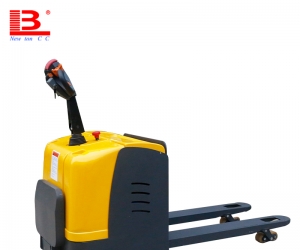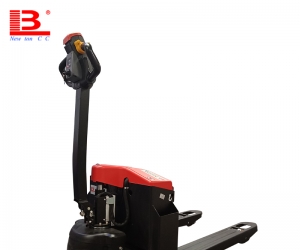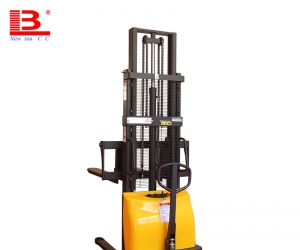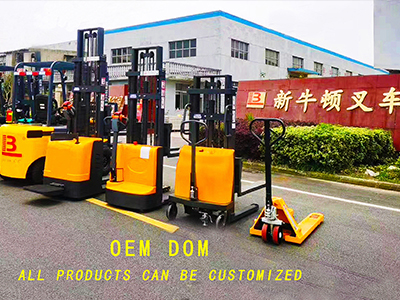
Usually we divide small electric forklifts into four-wheel forklifts and electric stackers, but there is another classification method to see if there are outriggers, which can be divided into two types: small electric forklifts with outriggers and small electric forklifts without outriggers .
Small electric forklifts without outriggers are also called counterbalanced electric forklifts. This kind of forklift has a heavier weight, and the load stacking is based on its own weight to balance the weight of the goods.
The small electric forklift with outriggers has a small weight. It relies on the supporting legs in front of the body to support the balance and share the weight of the cargo. The outrigger type small electric forklift can effectively reduce the gravity of the forklift. If an electric forklift needs to carry 1.5 tons of goods, then the weight of an electric forklift without outriggers needs to be more than 1.8 tons. However, the design of a small electric forklift without outriggers just made up for this shortcoming. The support point of the forklift is moved forward through the support legs ingeniously, combined with its own weight, so that the cargo is more stable and the load is increased.
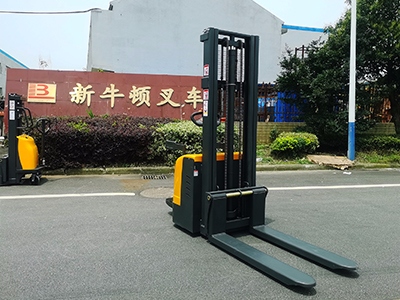
What are the advantages of small electric forklifts with outriggers?
1. The front and rear track of the electric stacker with outriggers has been increased, making the front and back movement of the economical full-electric stacker more safe and stable.
2. The electric stacker with outriggers uses the principle of leverage, which can effectively reduce its volume without increasing its own weight. When lifting 1.5 tons of Zhongling, its own weight is 750KG. In the product development stage, we can lift 1.5 tons of counterweight with a low-lift stacker with its own weight of 350KG.
Of course, the outrigger electric stacker also has its shortcomings:
1. Small electric forklifts with outriggers are not suitable for climbing. If the slope exceeds 7°, it will run aground, because the outriggers extend the length of the vehicle body touching the ground, and the outriggers with a slight slope will rub against the ground and cause the vehicle to run aground.
Electric stackers with outriggers have higher requirements for pallets. They can only use single-sided pallets, such as Chuan-shaped pallets and nine-legged pallets, but cannot use double-sided pallets, such as Tian-shaped pallets. For the size of the pallet, it is required to match the width of the legs. There are also requirements for the height of the tray. I won’t go into details about the pallet here. For detailed questions, please consult the warehouse forklift manufacturer.
-
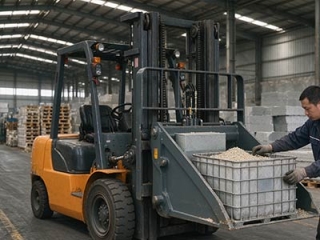 Customized Forklift Attachments to Meet Diverse Warehouse DemandsCustom forklift attachments handle irregular goods like pipes and rolls. Check gravity and load curve to avoid risks from shifted load center.
Do you like ?0
Read more -
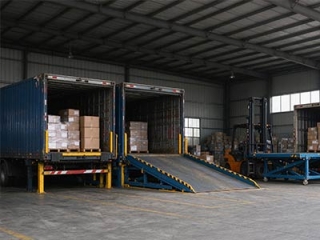 Hydraulic Dock Ramp: Fixed or Mobile Type for Warehouse LoadingFixed and mobile hydraulic dock levelers differ greatly in installation, load and flexibility. Match your dock, frequency and site to avoid mismatches.
Do you like ?0
Read more -
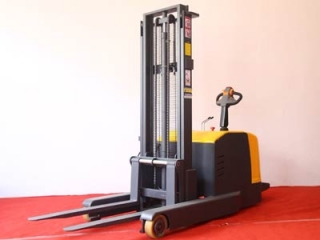 Stand-on Electric Reach Stacker Solution for Dense Racking Automated WarehouseStand-on reach stackers help new material warehouses expand storage slots without heavy construction. The telescopic mast cuts aisle width for dense racks.
Do you like ?0
Read more -
 Legless Walk Stacker Solve Space Limits for Fixed Warehouse RacksLegless walkie counterbalance stackers suit renovated old warehouses. They fit narrow aisles and closed-bottom pallets without rack modification.
Do you like ?0
Read more -
 AGV Forklift Fork Alignment Error Causes and Site Working Condition NotesAGV forklifts rely on sensors for auto fork alignment. Positioning is affected by site conditions. Understand alignment logic and control surroundings to reduce failures.
Do you like ?0
Read more -
 How Does Truck-Mounted Self-Lifting Stacker Work for City DeliveryLight electric self-loading stackers let one driver load pallets inside trucks without tailgates, yet they have limits on load, space and working conditions.
Do you like ?0
Read more