Stand-on Electric Reach Stacker Solution for Dense Racking Automated Warehouse
A new material enterprise built a raw material automated warehouse and met a conflict between storage capacity and aisle space during planning. With a fixed total warehouse area, the owner wanted to add as many rack positions as possible without expensive infrastructure for three-way stackers. After comparing counterbalance stackers and walk-behind stackers, the company finally chose the stand-on electric reach stacker as the main handling equipment.
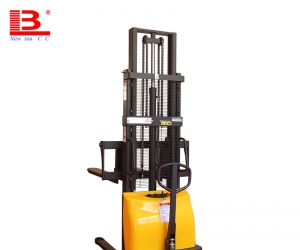
The telescopic mast of the stand-on reach stacker is its core advantage. The vehicle does not need to get close to racks. The mast extends forward to pick and place pallets, which reduces the required stacking aisle width and greatly increases rack positions within the same floor area. It works perfectly for automated warehouses and dense racking areas.
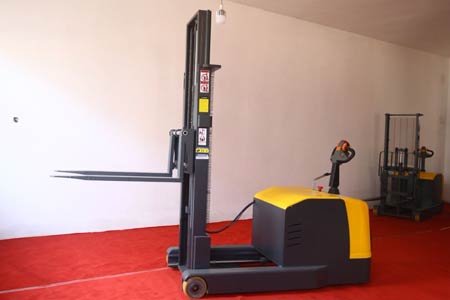
Other forklift models have obvious drawbacks. Counterbalance stackers rely on rear counterweights and need wide turning aisles, which will reduce available rack positions. Ordinary walk-behind stackers suffer severe load loss at high lifting heights. This warehouse has four layers of racks with heavy goods on upper levels, so they lack sufficient stability. Both options are inferior to reach stackers.
Operators stand on board for transfer along long aisles, achieving higher efficiency than walk-behind models. Proportional hydraulic control enables smooth mast lifting and forward movement. It helps align pallets accurately at height and lowers the risk of hitting rack beams. Lithium power supports all-day multi-shift operation to match continuous inbound and outbound flow of raw materials.
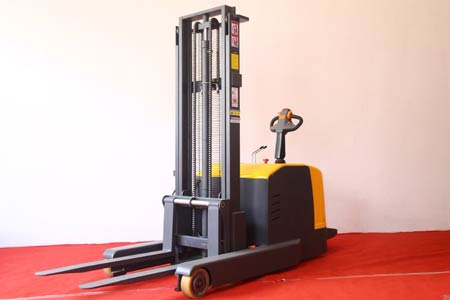
Two key limitations should be noted. The load capacity drops once the reach mast extends. The weight of all high-level goods must be calculated according to the load curve instead of only referring to the rated load on the nameplate. The warehouse floor must be flat. Height difference and ground settlement will amplify instability risks during high-level stacking.
This solution balances storage density, equipment cost and infrastructure investment. It works with standard beam racks without rack modification or guide rails. The reach stacker for high-density automated warehouse meets enterprise demands, cuts investment and expands usable storage space.
-
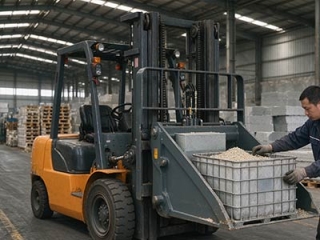 Customized Forklift Attachments to Meet Diverse Warehouse DemandsCustom forklift attachments handle irregular goods like pipes and rolls. Check gravity and load curve to avoid risks from shifted load center.
Do you like ?0
Read more -
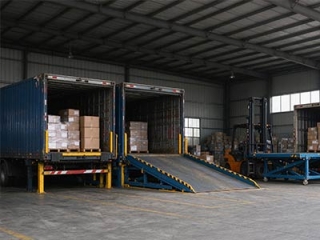 Hydraulic Dock Ramp: Fixed or Mobile Type for Warehouse LoadingFixed and mobile hydraulic dock levelers differ greatly in installation, load and flexibility. Match your dock, frequency and site to avoid mismatches.
Do you like ?0
Read more -
 Stand-on Electric Reach Stacker Solution for Dense Racking Automated WarehouseStand-on reach stackers help new material warehouses expand storage slots without heavy construction. The telescopic mast cuts aisle width for dense racks.
Do you like ?0
Read more -
 Legless Walk Stacker Solve Space Limits for Fixed Warehouse RacksLegless walkie counterbalance stackers suit renovated old warehouses. They fit narrow aisles and closed-bottom pallets without rack modification.
Do you like ?0
Read more -
 AGV Forklift Fork Alignment Error Causes and Site Working Condition NotesAGV forklifts rely on sensors for auto fork alignment. Positioning is affected by site conditions. Understand alignment logic and control surroundings to reduce failures.
Do you like ?0
Read more -
 How Does Truck-Mounted Self-Lifting Stacker Work for City DeliveryLight electric self-loading stackers let one driver load pallets inside trucks without tailgates, yet they have limits on load, space and working conditions.
Do you like ?0
Read more