Counterbalanced forklift stacking safety, are you doing it right?
To ensure safe stacking operations, operators must strictly adhere to the following precautions:
1. Load and stability
It is forbidden to overload and eccentric driving, and it is forbidden to stack eccentric loads.
Counterbalanced forklifts can only handle loads with a weight below the rated lifting capacity.
Overload handling can lead to loss of steering control, and the rear wheels are easy to leave the ground, which is very easy to cause accidents.
Warning: Overloading is forbidden for counterbalanced forklifts, otherwise uncontrollable events are prone to occur.
When stacking, it is necessary to ensure that the discharge of goods is safe and stable, the forks are accurately inserted into the pallet, and the center of gravity of the goods is consistent with the center of the counterbalanced forklift to avoid the goods falling or the counterbalanced forklift tipping.
2. Stacking height and safety distance
The height of the goods should not exceed the rack to avoid the goods slipping and injuring the operator.
When the fork is lifted, no one is allowed within a radius of 1 meter of the fork range.
3. Extra-long and extra-wide cargo handling
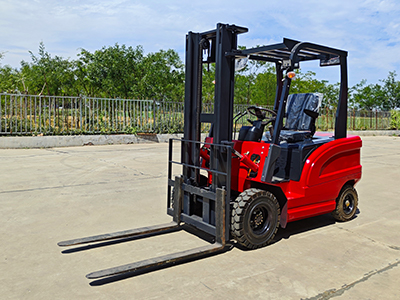
When handling extra-long and extra-wide cargo, drive with extra care, slow down, slow steering, and lifting.
Pay attention to the balance of goods and try to lower the goods.
Equipped with appropriate extended and widened fork frames.
Use pallets of the right size and strength to carry the goods.
Make sure the goods are secured to the pallet and have the right shape.
When the cargo is over-wide, be careful not to touch roadside objects when driving.
4. Mast operation
Before lifting the goods or starting the counterbalanced forklift, the mast should be tilted back into place to stabilize the goods.
In the state of forklifts, the gantry cannot be leaned forward.
When lifting and lowering goods, you should stop first.
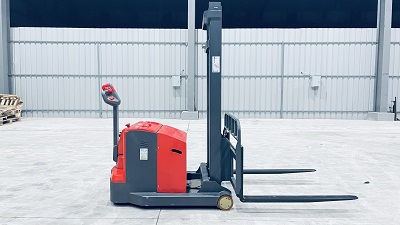
5. Driving and braking
Do not brake sharply when carrying goods to prevent the goods from sliding out.
6. Parking precautions
Try to avoid parking on slopes. If it is unavoidable, plug the wheels with a reliable object, tighten the handbrake and turn off the ignition.
When parked, the fork should be lowered to the lowest position, and the brake pedal should be pressed to the end to cut off the power supply circuit of the counterbalanced forklift.
Counterbalanced forklifts cannot be parked on sections of the road with a slope greater than 5%.
It is forbidden to park the counterbalanced forklift near flammable materials, emergency passages, entrances and exits, near fire hydrants, places that affect fire escapes, and next to fire fighting facilities.
Counterbalanced forklifts must be parked in a place that does not impede traffic safety.
The mast leans forward slightly, the forks are naturally lowered, the counterbalanced forklift forks are lowered to the ground, the key switch is turned off and the key is removed.
7. Prohibited Operations
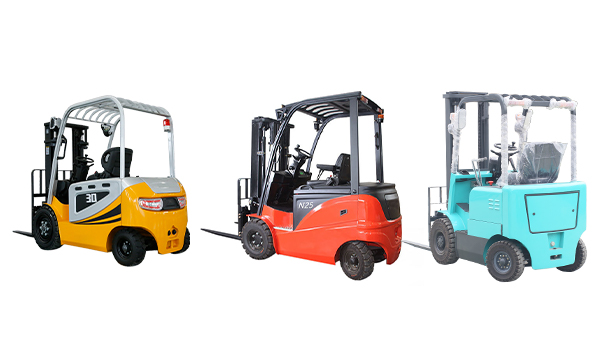
Prohibit parking and let the controller continue to work unattended.
It is forbidden to lift the cargo in the air while the driver leaves the driving position.
When stopping the counterbalanced forklift, be sure to remove the counterbalanced forklift key after turning off the power.
8. Charging Precautions (Lithium Battery Counterbalanced Forklift)
The battery can only be charged with the designated charger.
When charging, the counterbalanced forklift must be stopped, the forklift key must be removed, the battery guard must be opened, and no lifting or tilting operation must be carried out while charging.
After charging, you must turn off the power first, then pull out the charger plug, and hang the charger, and it is forbidden to put the charger plug on the ground at will.
Prevent the charging equipment from getting damp and prohibit excessive discharge. Do not use the counterbalanced forklift until it cannot be moved before stopping, when the battery capacity alarm indicator flashes continuously, the battery needs to be charged.
9. Precautions in case of accidents
If you encounter a rollover, you should lie down on the steering wheel or operating handle, lean on the reverse side of the counterbalanced forklift dumping direction, and pay attention to prevent damage to the head or chest.
WARNING: When the counterbalanced forklift is tipping over, do not jump out of the vehicle.
When the counterbalanced forklift is running, if the controller is out of control, the main power supply of the counterbalanced forklift should be turned off immediately.
-
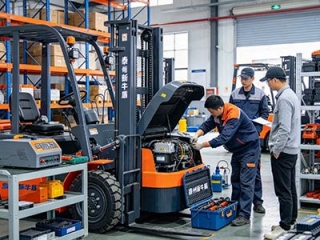 Taizhou newnewton Forklift Manufacturer IntroductionAvoid selecting warehouse forklifts only by unit price. Check site conditions, certificates and after-sales. Newnewton, Taizhou source factory, provides full product range, CE certification, customization and reliable spare parts supply.
Do you like ?0
Read more -
 Semi-electric Stacker vs Manual Stacker Cost ComparisonWhen buying stacking equipment for small warehouses, compare semi-electric stackers and manual stackers from cost, efficiency and maintenance to balance upfront expense and long-term investment.
Do you like ?0
Read more -
 CE Certification for Manual Hydraulic StackerNewnewton manual hydraulic stackers exported to EU need CE certification complying with 2006/42/EC and EN1757-1, including safety assessment, technical documents and product compliance checks.
Do you like ?0
Read more -
 Stand-on vs Walk-behind Electric Pallet Truck ComparisonUnderstand the differences between stand-on and pedestrian electric pallet trucks in operation, efficiency, aisle requirements and costs. Choose the right model based on warehouse scale, transfer distance and order volume.
Do you like ?0
Read more -
 Operation Notes for Electric Self Elevating TruckPedestrian electric stackers cover tiered brand options with different features. International brands offer stable performance at high cost, while domestic brands and factory suppliers provide better cost performance and customization.
Do you like ?0
Read more -
 Operation Notes for Electric Self-elevating Truck | Truck Mounted Forklift SafetTruck-mounted self-loading forklifts fixed on truck tails handle cargo without loading docks. Control load and cargo gravity, inspect equipment and avoid soft slopes to prevent tipping and falling goods.
Do you like ?0
Read more