Why does the electric forklift fail to move forward and backward?
Why does the electric forklift fail to move forward and backward? What is the solution? There are roughly several reasons why electric forklifts cannot move forward and backward. In addition, I have attached a solution, I hope it will be useful to everyone.
1. The battery of the electric forklift is insufficient or invalid. Repair method: charge in time. If it cannot be charged, please check whether the forklift charger or forklift battery is faulty according to the following points.
① Check whether the forklift charger is faulty? If so, find an electric forklift manufacturer to solve it.
② After the forklift charger is connected, is there an electrical output with a clamp meter?
③ Check whether the charging terminal is loose or oxidized. If there is, it will cause poor contact and unable to charge.
④ Has the forklift battery been left for too long, causing serious vulcanization of the battery pack base material?
⑤ Use a multimeter to measure whether the voltage of the forklift battery meets the standard voltage of the battery.
⑥ After the above exclusion is completed, it still doesn't work. Find the manufacturer or professional repair.
2. The driving control micro switch of the electric forklift is loose. Repair method: tighten the screws.
3. The DC contactor of the electric forklift is faulty and needs to be repaired and replaced.
4. If the electric control board of the electric forklift is damaged, the electric control board should be repaired or replaced by professionals. For inspection and maintenance, please refer to the following points:
① Check whether there is burnt, burnt, blistering, explosion, board surface damage, rusty socket, etc. on the surface of the forklift main board.
② Multimeter measurement method: Whether the +5V and GND resistance are too small (below 50 ohms).
③ Power-on inspection: For the obviously broken board, you can slightly increase the original voltage by 0.5-1V, and rub the IC on the board after power-on, so that the problematic chip will heat up, which will be sensed.
④Logic pen check: check whether the signal of the key suspicious IC input, output, and control terminal is present, and the strength, etc. 5. According to the instructions in the manual, first check whether there is a signal (waveform) at the input and output terminals of the suspicious chip. If there is input or output, check the IC control line signal (clock), etc. If there is this IC is probably broken and there is no control signal. Trace to its previous pole until you find the damaged IC.
5. Forklift drive motor failure, check the following points and focus on repairs.
① The forklift drive motor cannot be started, which may be caused by blown fuse, blockage of control circuit, severe short circuit or open circuit of motor winding, short circuit between commutator segments, poor contact of brushes, heavy load or mechanical damage such as bearings...
② The abnormal speed of the forklift drive motor may be caused by short-circuit or open circuit of the winding, incorrect brush position and overload, damage to the bearing, low power supply voltage, etc.
③ Sparks generated by forklift drive motor brushes may be caused by poor contact of forklift brushes, uneven commutator surface, improper brush position, dirty surface, commutator short-circuit or motor winding short-circuit.
④ High temperature may be caused by overload, forklift bearing and oil seal too tight, damage or poor lubrication, shaft core incorrect, armature and magnetic pole friction, winding short circuit, excessive brush pressure, incorrect position, poor rectification, etc.
⑤ The forklift drive motor is noisy, which is mainly caused by the damage of the bearings of the electric forklift parts, the uneven surface of the commutator, and the vibration or friction of the electric brush.
6. The brake of the electric forklift is locked. Maintenance method: There are many reasons for electric forklift brake failure, including the following three points. One is that the forklift brake system is not regularly maintained. Excessive impurities in the master brake cylinder, poor sealing, failure of the vacuum booster pump, dirty brake fluid, or mixed use of several brake fluids, air resistance occurs after heating, oil leakage from the master brake cylinder or sub-cylinder, gas storage tank or The pipe connection is leaking, and the oil pipe is not blocked. The second is mechanical failure due to improper operation or attempts to adjust the distance of the drive wheel brake pads. The third is to replace the oil in the brake cylinder of the forklift and vent the air before adjusting the local brake.
7. The electric forklift does not move at all
① Check whether the electric door lock is opened or damaged. Repair method: directly replace with a new electric door lock.
② Whether the battery is charged or not, the battery power is insufficient. Repair method: replenish the battery power and charge.
-
 Stand-on Double Pallet Stacker Pros & Cons For High Throughput WarehouseIn high-turnover e-commerce warehouses, stand-on electric double pallet stackers carry two pallets at once to boost outbound efficiency. Check aisle space before purchase as the machine has a wider body.
Do you like ?0
Read more -
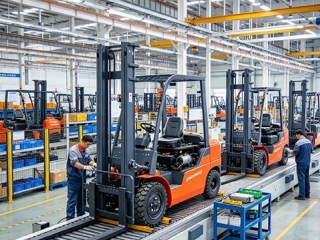 Newniudun Forklift OEM Service, Taizhou Newniudun ForkliftBuilding your own forklift brand does not require self-built production lines. OEM manufacturing is ideal for traders. newnewton forklift provides equipment OEM, logo customization, export certification and stable supply.
Do you like ?0
Read more -
 3 Core Rules for Small Warehouse Forklift SelectionMany buyers blindly pursue high load and lifting parameters for forklifts. Small warehouses need forklifts matched by aisle space, cargo demands and full-cycle costs for proper operation and budget control.
Do you like ?0
Read more -
5 Forklift Selection Tips for Small EnterprisesSmall enterprises often focus only on forklift unit prices and ignore actual warehouse conditions, leading to unusable equipment. Select suitable forklifts from five dimensions: aisle, cargo, environment, maintenance and certification.
Do you like ?0
Read more -
 4WD Rough Terrain Forklift For Muddy Construction Site, Anti-stuck Off-road ForkOrdinary forklifts slip and get stuck on muddy post-construction sites. 4WD off-road forklifts with upgraded tires and high chassis adapt to unhardened ground for stable outdoor material handling.
Do you like ?0
Read more -
 3 Steps To Troubleshoot Black Smoke Of Fuel Forklift, Reduce Equipment LossBlack smoke from fuel forklifts results from insufficient combustion and worsens engine wear and fuel consumption. Troubleshoot the air intake, fuel system and engine conditions to eliminate smoke faults efficiently.
Do you like ?0
Read more