Can Electric Forklift Motor Controller Be Used On Walk-behind Straddle Stacker?
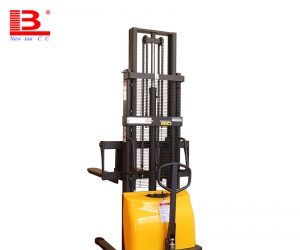
Can you install a spare electric forklift motor controller onto a broken Walk-behind Straddle Full Electric Stacker? Many purchasers and maintenance technicians intend to reuse controllers from counterbalance electric forklifts to cut costs. Theoretically, these motor controllers share similar hardware principles, yet they cannot be applied directly.
Below is the detailed comparison explaining the incompatibility:
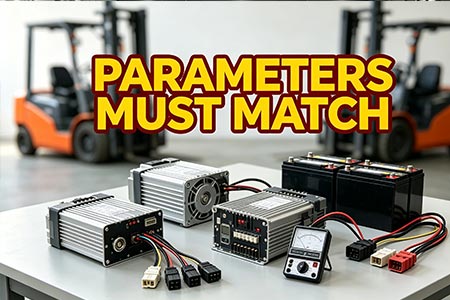
Mismatched Rated Voltage & Continuous Current Most walk-behind straddle stackers adopt a 24V power system. Medium & small counterbalance electric forklifts generally run on 48V / 80V systems. Voltage mismatch is the primary risk: Installing a 48V forklift controller on a 24V battery leads to insufficient power; A 24V controller connected to 48V power supply will burn power transistors instantly.
Even with identical system voltage, continuous output current differs greatly: Walk-behind stackers have smaller drive motors, with controller continuous current ranging from 80A–150A. Counterbalance forklifts carry heavier loads, whose controllers normally support 200A–350A continuous current. Although high-current controllers feature larger hardware tolerance, unmatched parameters cause harsh startup impact and abnormal ramp braking logic without calibration.
Motor Type & Driving Mode Must Be Matched Two categories cannot be interchanged: Brushed DC motor controller — only for brushed travel motors. AC brushless controller — exclusively for 3-phase AC motors, requiring matching Hall encoder signals. If the forklift uses an AC controller while the straddle stacker is fitted with a brushed motor, different underlying driving architecture makes normal operation impossible regardless of wiring adjustment.
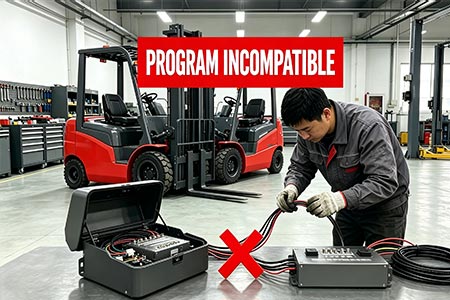
Different Operation Signals & Tiller Logic Walk-behind straddle full electric stackers receive potentiometer signals from walkie tillers, with built-in functions: auto brake on handle release, emergency reverse, turtle speed mode and high-lift speed limit for stacking. Rider electric forklifts adopt pedal accelerator signals paired with steering wheel logic. Even if hardware is interchangeable, factory pre-programmed parameters including acceleration curve, brake feedback, turning speed limit and anti-rollback settings are customized for each vehicle model. Without reprogramming via programmer, severe safety hazards emerge: abrupt startup, failed auto parking, ramp sliding and disabled lifting interlock protection.
Non-interchangeable Wiring Harness Connectors & Pin Definitions Different controller models from the same brand (Curtis, ZAPI, Xinlianda etc.) have different pin layouts; Controllers from different brands cannot be plugged in directly. Wiring harness for walk-behind stackers covers tiller signal, emergency stop, electromagnetic brake, lift interlock and battery indicator circuits. Rider forklift harness adds extra loops: pedal input, steering controller communication and seat safety switch. Forced rewiring risks incorrect power or brake circuit connection and loss of safety protection functions.
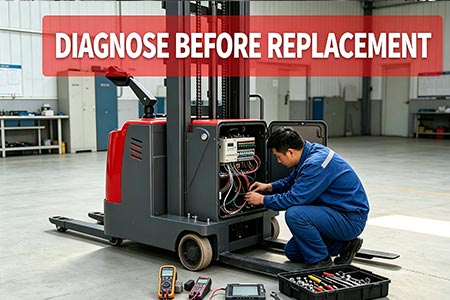
Vehicle-specific Safety Protection Routines Walk-behind straddle stackers are lightweight with high center of gravity, so controllers embed low-speed protection and high-lift speed limit programs. Counterbalance forklifts carry heavy counterweights and allow higher travel speed in control strategy. Directly applying forklift firmware to walk-behind stackers removes necessary speed restrictions during high-speed turning or high-load lifting, greatly increasing rollover risks.
In conclusion, electric forklift motor controller cannot be directly fitted onto walk-behind straddle stackers. Maintenance work must be carried out cautiously.
When can cross-model compatibility be achieved? All prerequisites must be satisfied simultaneously: identical system voltage, consistent motor driving type, programmable universal controller and dedicated handheld programmer. We will elaborate on these restrictions in the next article.
-
 Direct Source Factory for Small Electric Forklifts | NewnewtonBuying forklifts from source factories saves markup and speeds up after-sales service. Check qualifications carefully to distinguish real manufacturers from OEM traders.
Do you like ?0
Read more -
 5 Troubleshooting Reasons for Slow Lifting Speed of Electric ForkliftSlow fork lifting is a common electric forklift fault. Check battery voltage, hydraulic oil, filter, pump and multi-way valve to quickly locate the root cause.
Do you like ?0
Read more -
 Lithium-ion Warehouse Forklift Brands Review, Advantages and DisadvantagesLithium forklift brands vary greatly, including major manufacturers, original factories and dealers. Compare Heli, Hangcha, Noblift, BYD to select models matching your budget.
Do you like ?0
Read more -
 Price Reference of Hydraulic Dock Leveler for Warehouse Loading BayHydraulic dock levelers include fixed and mobile types with large price gaps. Load capacity, steel and hydraulic systems are key factors to consider for procurement.
Do you like ?0
Read more -
 Charging & Storage Taboos for Lithium-ion Double Pallet Electric TruckLithium battery double pallet trucks suffer heavy discharge under load. Follow charging, storage and operation rules to slow cell aging and cut replacement costs.
Do you like ?0
Read more -
 High-level Stacking Safety Notes for Electric Three-way ForkliftThree-way electric forklifts face collision and falling risks in narrow aisles. Follow standard operating procedures for pre-check, traveling, stacking and finishing to ensure warehouse safety.
Do you like ?0
Read more