
Walk‑Behind Electric Stacker & Straddle Stacker | Special‑Equipment Compliance G
Many buyers wonder whether walk‑behind electric stacker falls under special‑equipment supervision. According to Chinese technical specification TSG 81‑2022 for industrial trucks, clear criteria are defined for special‑equipment classification. Walk‑behind follow‑type stackers differ from rider‑on forklifts. Most semi‑electric stackers are exempt from special‑equipment administration. However, regulatory enforcement standards for full‑electric walk‑behind full‑electric straddle stacker vary across regional market‑supervision authorities. It is recommended to confirm local requirements before purchase.
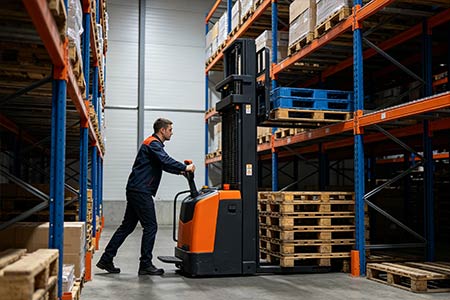
To be classified as special‑equipment forklift, the unit must satisfy all conditions: self‑powered travel, lifting mast and forks, manual operator control, and operation within closed factory premises.
Confusion frequently occurs for pedestrian‑following models. Not all full‑electric walk‑behind stackers are compulsorily registered as special‑equipment. Semi‑electric stackers, with manual propulsion, are mostly excluded from special‑equipment inventory.
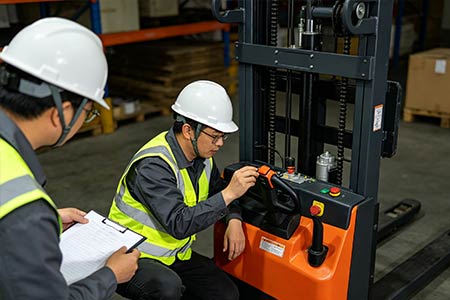
Enterprises shall complete two compliance self‑checks before procurement. First, consult local market‑supervision bureau to clarify local enforcement rules, confirming whether registration and N1 operator certification are required, so as to avoid risks caused by regional policy differences.
Second, select equipment according to pallet type, aisle width and stacking height. Straddle stackers deliver high cost‑performance for standard pallets and narrow aisles. Counterbalance stackers without support legs are preferred when irregular or bottomless pallets are frequently handled.
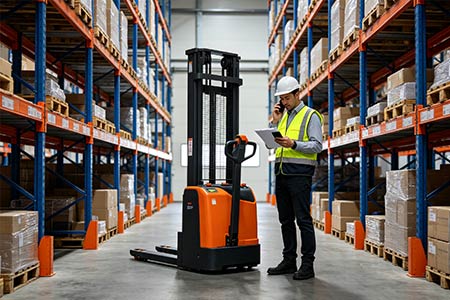
Even if the machine is ruled out of special‑equipment scope, safety management cannot be neglected. Lifting operations carry risks of cargo tipping. Operators must receive pre‑job training. Implement daily inspection routines for hydraulic system, brakes and emergency‑stop devices. Forbid overloading, sharp turning and fast high‑altitude lifting.
To sum up, when purchasing walk‑behind full‑electric straddle stacker, price and quality are not the only factors. Local regulatory requirements shall also be considered to balance safety and performance. Contact us for professional consulting if you are unsure about local compliance rules.
-
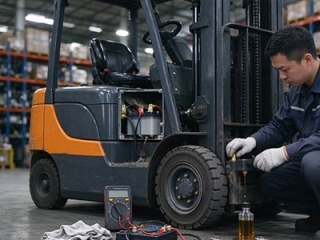 Reliability Of Newnewton Warehouse Forklifts For Heavy-Duty ShiftsWarehouse forklift reliability relies on industrial parts, reinforced frames and factory durability tests. Proper operation and maintenance reduce unexpected downtime.
Do you like ?0
Read more -
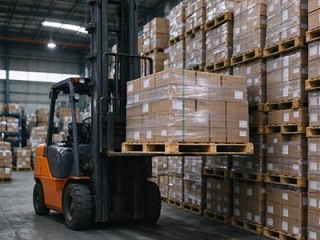 Forklift Configuration Strategy For Dense Warehousing, Warehouse ForkliftDense warehousing needs matched forklifts besides racks. Reach and trilateral stackers fit different layouts, coordinate aisle, load curve and floor for smooth handling.
Do you like ?0
Read more -
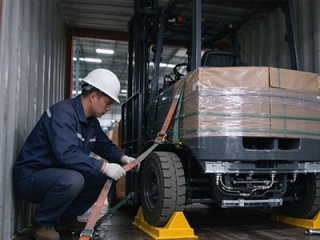 Full Container Supply For Export Forklifts, Forklift ManufacturerBulk forklift orders for overseas can ship by FCL or LCL. Newnewton FCL offers stable freight, safer packing and mixed models for large purchases.
Do you like ?0
Read more -
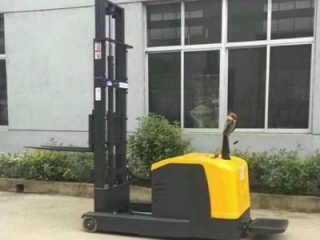 Stand-on Reach Stacker For Narrow Aisle Stacking, Mast Reach StructureStand-on reach stackers feature sliding masts that stay outside racks. They boost storage density in narrow aisles and require flat floors and standard pallets.
Do you like ?0
Read more -
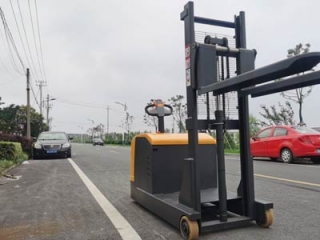 Stand-on Counterbalance Stacker For Various Pallets, Why No Leg RestrictionCounterbalance stackers have no front outriggers, using rear counterweight to avoid pallet interference. They fit various odd pallets yet need wider warehouse aisles.
Do you like ?0
Read more -
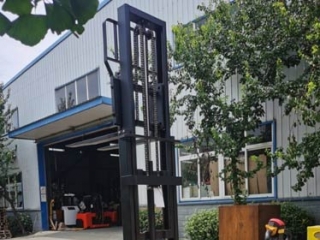 Custom Walk-Behind Counterbalance Stacker | Non-Standard ModificationsStandard walk-behind counterbalance stackers struggle with non-standard pallets and tight aisles. Customize load, lift, forks and structure, share working conditions for safe design.
Do you like ?0
Read more








