
Many warehouses use pallets of different sizes at the same time. Fixed outrigger stackers often rub against the bottom of pallets and fail to fork goods smoothly. Frequent equipment replacement slows down work. The walkie straddle electric stacker with adjustable outriggers can fit various pallets by changing outrigger width. If you wonder how to adjust outrigger width of straddle stacker, here is the introduction.
Different from counterbalance stackers, straddle stackers are supported by two side outriggers outside pallets. The distance between outriggers decides which pallet widths it can handle.
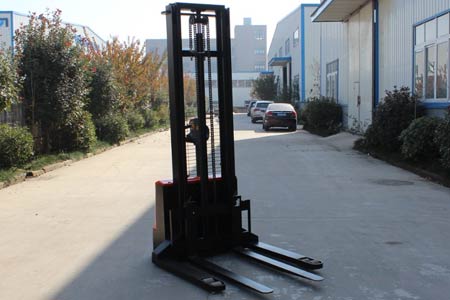
Adjustable outriggers mainly have two structures: pin hole adjustment and hand crank sliding adjustment. The pin type locks outriggers by inserting pins into different positioning holes, stable for long-term fixed sizes. The screw hand crank type supports stepless adjustment within range and switches pallet sizes faster for warehouses with frequent pallet changes.
Stop the machine and cut off power before adjustment. Lower forks fully and make sure the ground is flat and firm to prevent tipping. Move the left and right outriggers synchronously to keep equal spacing and avoid skew. Lock pins or tighten screw nuts firmly after adjustment to stop outriggers from shifting during operation.
Carry out no-load travelling and lifting tests after adjustment to make sure outriggers will not scratch pallets before heavy load operation.
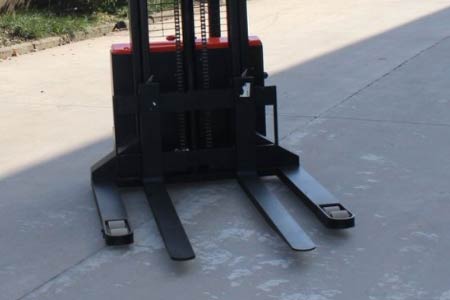
If your warehouse uses standard 1200*1000 pallets together with narrow and non-standard pallets, check the adjustment range besides the adjustable function. The minimum and maximum width should cover the outer size of your commonly used pallets with proper clearance, so outriggers will not scrape pallets on bumpy roads.
Floor conditions also matter. Outriggers support the whole machine, and potholed ground reduces stability and raises risks under heavy stacking. Note its limits. The adjustment range is limited. Pallets that are too wide or too narrow cannot be handled even with adjustment. Adjustable structures are more complex than fixed ones, so pins and screws need regular inspection.
Walkie straddle electric stacker meets the demand of mixed pallet handling. Feel free to contact us for more information.
-
 Three Certificates For Legal Operation Of Site Diesel ForkliftHeavy-duty diesel forklifts on construction sites require N1 operator certificate, equipment registration and biennial inspection reports instead of driving licenses. They must not run on public roads for safety audits.
Do you like ?0
Read more -
 Lithium Double Pallet Stacker For E-Commerce Peak ShipmentE-commerce warehouses face aisle congestion during peak sales. Lithium stand-on double pallet stackers carry two pallets per trip with fast charging to speed shipments. Verify aisle, pallet and floor conditions before selection.
Do you like ?0
Read more -
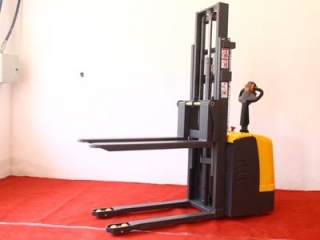 Key Parameters For Narrow Aisle Rider Stacker SelectionFor narrow-aisle stand-on electric stackers in dense warehouses, check aisle width, load center, mast and turning radius besides capacity and lift height. Leave safety margin; do not rely only on no-load data.
Do you like ?0
Read more -
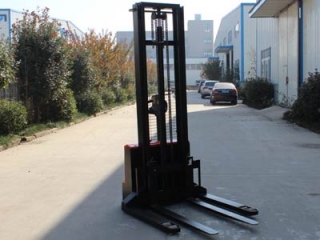 Adjustable Outrigger Straddle Stacker For Mixed PalletsMixed pallet sizes cause jamming risks. Adjustable-straddle walkie electric stackers have two adjustment structures: bolt holes and hand screws. Power off before adjusting, lock legs and confirm the range matches pallets.
Do you like ?0
Read more -
 Walkie And Rider Stacker Comparison For Warehouse SelectionBuyers often choose between walkie and stand-on electric stackers. Compact low-cost walkie models suit short trips in narrow aisles, while stand-on versions ease long multi-shift work. Evaluate aisle, distance and workload.
Do you like ?0
Read more -
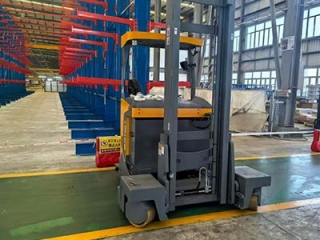 Selection Guide Of Four-Way Forklift For Profile WarehouseLong profiles and pipes take wide aisles and are hard to turn. Four-directional electric forklifts travel crosswise without sharp turns to save space. Check cargo size, floor and battery and know its limits.
Do you like ?0
Read more








