
Is the automatic lifting platform not as safe as the manual lifting platform?
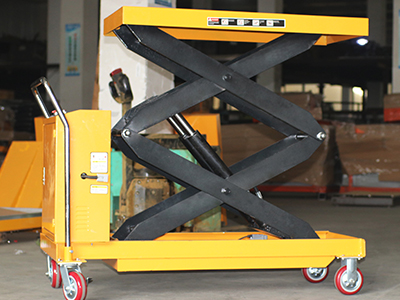
Before discussing the safety of the fully automatic lifting platform and the manual platform scissor lift, let's first understand some of the working principles and uses of these two models.
There are many kinds of automatic lifting platforms. Here we mainly introduce small electric lifting platform vehicles, which are lifting equipment with electric power as the power source. Fully automatic lifting platform vehicles are often used for material transportation of assembly line parts in production workshops. Supporting use of work equipment with a drop. Some of the electric platforms are plug-in, the length of the cable is limited, and the operating range of the car is also limited. Now few customers use it. The most commonly used is the electric lifting platform equipped with a battery, and the operating range is not limited. In general, the electric lifting platform is equipped with a device to limit overload. If the platform truck is overweight, it cannot be lifted, and the overweight will relieve the pressure. The lifting and lowering of the electric platform truck has a guide wheel that moves on a fixed track to promote the expansion and contraction of the scissor fork to raise or lower the table.
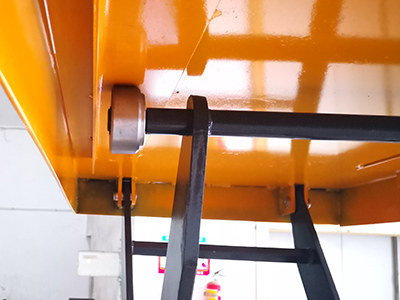
The lifting height of the fully automatic lifting platform truck can be lifted freely within the maximum height range, and the height can be adjusted according to the needs. The lifting speed is uniform and there is no speed adjustment. It can be started and stopped at any time by button operation.
The manual lifting platform is completely operated by manpower to carry out a series of movements such as lifting and moving. Its function is the same as that of the electric lifting platform. Of course, the work efficiency is not as good as electric. The manual lifting platform is raised by foot and lowered by hand. The speed is also not adjustable, and the lifting height can be adjusted at will within the maximum lifting range. If the load is overweight, there will be pressure relief restrictions.
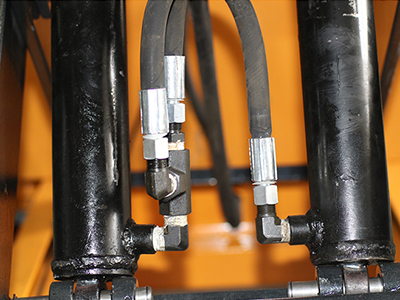
Judging from the above content, in addition to the different power sources, many of these two lifting platform vehicles are technically mature mechanical equipment, and they can be used with confidence.
-
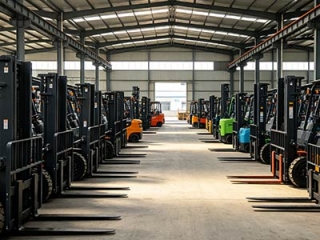 Newnewton Forklift: Source Factory with Independent Manufacturing CapacityOverseas buyers prefer real manufacturers over resellers. Newnewton Forklift is a direct factory with full in-house production, custom service and complete export certifications for warehousing equipment.
Do you like ?0
Read more -
 What to Note When Using Lithium Electric Forklifts in Cold StorageLow temperature and frost in cold storage age lithium electric forklift components. Adopt cold-resistant models and standardize charging and operation to stabilize warehouse handling and reduce breakdowns.
Do you like ?0
Read more -
 4 Delivery Capabilities to Evaluate Warehouse Forklift Export FactoriesFor bulk overseas warehouse procurement, multiple suppliers bring high communication costs and messy documents. Evaluate manufacturers by four capacities: full product supply, export docs, customization and after-sales spare parts.
Do you like ?0
Read more -
 Stand-on Warehouse Stacker: Racking Matching & Core StrengthsRide-on electric stackers feature compact size and flexible steering. They fit multiple rack types including beam, narrow aisle and shelving racks to boost warehouse operational efficiency.
Do you like ?0
Read more -
 3 Parameters to Check if Double Fork Stand-on Stacker Fits Euro PalletsForeign trade warehouses often ignore pallet compatibility when purchasing ride-on double-fork stackers. Check fork width, fork length and ground clearance to fit EU pallets and avoid operation failures.
Do you like ?0
Read more -
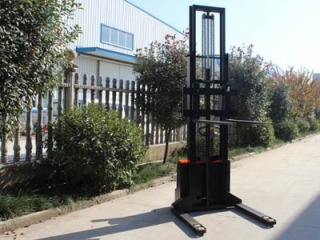 Advantages of Walk-behind Electric Stacker with Adjustable LegsAdjustable leg electric stackers flexibly adapt to various pallet sizes. The compact walking design solves messy pallet specifications and reduces warehouse equipment procurement costs.
Do you like ?0
Read more








