Narrow Aisle Forklift vs Ordinary Forklift, Core Comparison Points
Before purchasing forklifts, buyers need to learn the differences between various forklift types and master basic knowledge of forklift selection. Sufficient preparation can avoid wrong model selection which delays project schedules. This article compares narrow aisle forklifts and ordinary forklifts to clarify how to distinguish narrow aisle forklift from ordinary forklift.
Minimum working aisle width
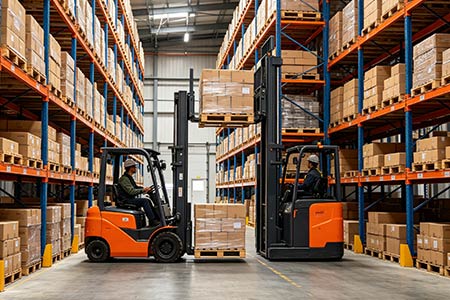
Standard counterbalanced forklifts turn the whole vehicle and require wider aisles. For 3-ton internal combustion or electric counterbalanced forklifts, the working aisle width is generally over 3.5 meters. Narrow aisle forklifts include reach trucks and three-way stacking forklifts. Their minimum working aisle can be reduced to 1.8 to 2.8 meters, greatly improving the storage density of warehouse racks.
Vehicle structure design
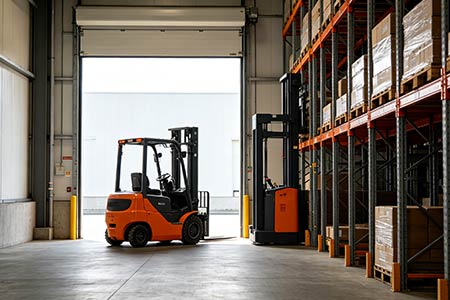
Ordinary forklifts are equipped with rear counterweights to offset the moment of cargo. They have longer body and large turning radius. Most narrow aisle forklifts adopt reach mast or three-way fork structure. They do not need large-scale body turning. Stacking is realized through mast forward movement or fork rotation. The whole machine has a shorter body without requiring wide turning space.
Stacking operation mode
Ordinary forklifts need to turn the whole vehicle to align forks with pallets, and the vehicle position changes greatly during loading and unloading. Narrow aisle forklifts keep the body moving straight basically. Pallet picking and placing are completed in place through mast expansion and contraction or left-right rotation of forks. They deliver better stability for high-level stacking and suit high rack operations.
Applicable warehouse scenarios
Ordinary forklifts are suitable for sites with wide aisles, mixed cargo types and outdoor transfer. They handle both short-distance transportation and stacking tasks. Narrow aisle forklifts are designed for indoor high-rise stereoscopic warehouses and mainly complete rack access. They are less efficient for long-distance transfer and not fit for uneven outdoor ground.
To judge how to distinguish narrow aisle forklift from ordinary forklift, calculate the available aisle width and rack height of the warehouse first. Choose ordinary forklifts if aisles are spacious and outdoor transfer is required. Pick narrow aisle forklifts to increase storage capacity and store goods densely on high racks. Feel free to contact us if you have any questions about these two types of forklifts.
-
 Narrow Aisle Forklift vs Ordinary Forklift, Core Comparison PointsDistinguish narrow aisle forklifts from standard ones to avoid wrong selection. Compare aisle width, structure and stacking method for your warehouse.
Do you like ?0
Read more -
 4 Dimensions to Reference Domestic Electric Forklift Brand RankingMany buyers select forklifts only by brand rankings, which may mismatch working conditions. Evaluate brands from statistics, application, after-sales and quality control.
Do you like ?0
Read more -
 Warehouse Transfer Application of Walk-behind Electric Pallet JackPedestrian electric pallet trucks are widely used in small warehouses. Check factory capacity, quality inspection, warranty and CE documents for export orders.
Do you like ?0
Read more -
 3 Key Checking Points for Walk-behind Counterbalanced Stacker Export InquiryDealers purchasing counterbalance electric stackers for export may overlook details. Check config, trade terms & certificates to avoid extra costs and risks.
Do you like ?0
Read more -
 Nylon Wheel vs PU Wheel for Manual Pallet Jack, Selection GuideManual pallet trucks use nylon or PU wheels. They differ in floor protection, noise, wear resistance and cost. Choose wheels by warehouse floor conditions.
Do you like ?0
Read more -
 Cold Storage Forklift Guide: Condensation Protection & TroubleshootingForklifts get condensation while entering & exiting cold warehouses, causing short circuits and rust. Use transition zone and moisture protection to extend service life.
Do you like ?0
Read more