
Internal Combustion Forklift Power System Working Principle Explained
Many forklift operators master driving skills, yet struggle to find root causes when malfunctions occur. Learning the Internal Combustion Forklift Power System Working Principle helps you accurately identify and troubleshoot faults timely.
Most mainstream Diesel Forklift adopts four-stroke diesel engines. The core function is converting chemical energy of diesel into mechanical rotation energy of the crankshaft through continuous cycles of intake, compression, power and exhaust strokes.
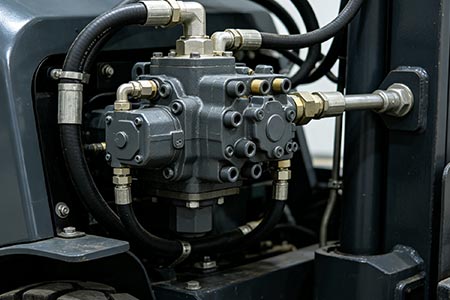
Intake stroke: Intake valve opens, piston moves downward, drawing clean air into the cylinder.
Compression stroke: All valves close; piston rises to compress air, sharply raising temperature inside the cylinder.
Power stroke: High-pressure injector sprays atomized diesel. Fuel self-ignites under high temperature, gas expansion pushes the piston down and drives the crankshaft to output torque.
Exhaust stroke: Exhaust valve opens, piston moves upward to discharge burnt exhaust gas, and a new cycle begins.
Sustained cyclic operation supplies steady power for the forklift.
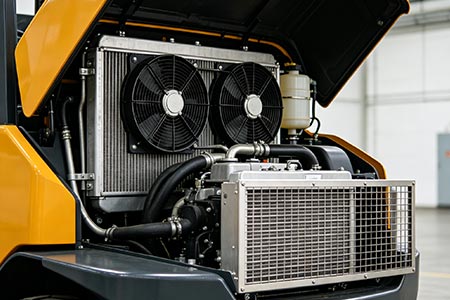
Complete Power Transmission Routes Of Diesel Forklift
Travel power line Crankshaft → torque converter → transmission → drive shaft → drive axle → drive wheels, controlling forward, reverse and steering. The torque converter transfers power via hydraulic oil, cushioning impact from frequent start-stop and enabling smooth startup during loading work. It is standard for automatic-shift internal combustion forklifts used in factories.
Hydraulic lifting line The crankshaft directly drives the hydraulic gear pump. The pump generates high-pressure oil delivered to lift cylinders and tilt cylinders to realize fork lifting, lowering and mast tilting.
In short, one single engine powers both vehicle travelling and cargo lifting. When travelling and lifting heavy loads simultaneously, the engine reaches peak load, demanding stable air intake and fuel supply.
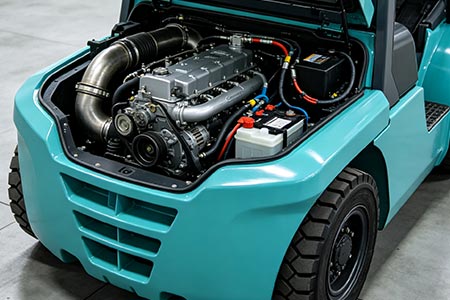
Root Causes Of Common Power Abnormalities
Clogged air filter reduces air intake → incomplete combustion → weak power & higher fuel consumption.
Carbon buildup & poor atomization of injectors → hard startup and insufficient lifting power under heavy load.
Degraded or insufficient engine oil → dry internal friction, louder noise and accelerated component wear.
Scaling inside radiator weakens heat dissipation → engine overheating activates protection mode with limited power output.
This basic introduction covers the power system of . We will release more related technical articles later. Leave a comment if you want to learn other forklift knowledge!
-
 Direct Source Factory for Small Electric Forklifts | NewnewtonBuying forklifts from source factories saves markup and speeds up after-sales service. Check qualifications carefully to distinguish real manufacturers from OEM traders.
Do you like ?0
Read more -
 5 Troubleshooting Reasons for Slow Lifting Speed of Electric ForkliftSlow fork lifting is a common electric forklift fault. Check battery voltage, hydraulic oil, filter, pump and multi-way valve to quickly locate the root cause.
Do you like ?0
Read more -
 Lithium-ion Warehouse Forklift Brands Review, Advantages and DisadvantagesLithium forklift brands vary greatly, including major manufacturers, original factories and dealers. Compare Heli, Hangcha, Noblift, BYD to select models matching your budget.
Do you like ?0
Read more -
 Price Reference of Hydraulic Dock Leveler for Warehouse Loading BayHydraulic dock levelers include fixed and mobile types with large price gaps. Load capacity, steel and hydraulic systems are key factors to consider for procurement.
Do you like ?0
Read more -
 Charging & Storage Taboos for Lithium-ion Double Pallet Electric TruckLithium battery double pallet trucks suffer heavy discharge under load. Follow charging, storage and operation rules to slow cell aging and cut replacement costs.
Do you like ?0
Read more -
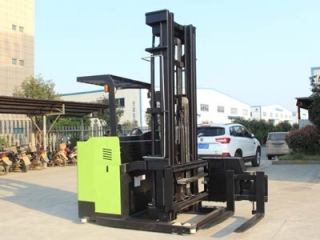 High-level Stacking Safety Notes for Electric Three-way ForkliftThree-way electric forklifts face collision and falling risks in narrow aisles. Follow standard operating procedures for pre-check, traveling, stacking and finishing to ensure warehouse safety.
Do you like ?0
Read more








