
Why Choose 4WD Rough Terrain Forklift For Mountain & Slope Handling Work
Standard warehouse forklifts cannot handle sloped terrain well and face high risks of turnover and sliding when transporting goods on mountain slopes. Many construction sites, orchards and open gravel yards make purchasing mistakes. If indoor warehouse forklifts are deployed on outdoor slopes, issues such as spinning drive wheels, vehicle sliding and chassis grounding will occur frequently. The ideal solution is to select qualified mountain off-road forklift.
Most indoor forklifts adopt two-wheel drive. The shift of center of gravity during slope start reduces pressure on drive wheels, which easily causes wheel spin. The 4WD all-terrain forklift is equipped with four-wheel synchronous drive system, and optional part-time four-wheel drive mode. On slopes and slippery muddy ground, four wheels output power simultaneously. When one wheel slips, other tires can still provide traction, greatly reducing risks of sliding and stalling.
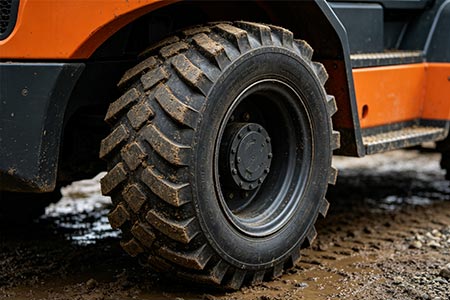
Conventional counterbalance forklifts usually have only 100–150 mm loaded ground clearance. Potholes and gravel on the ground are likely to scratch the chassis and oil pipelines. The 4WD all-terrain forklift generally achieves loaded ground clearance above 260 mm, with larger approach and departure angles. It can smoothly cross mounds, gravel and shallow pits to prevent chassis damage. For long-term work on muddy ground after rain, the elevated chassis reduces mud accumulation, protects hydraulic pipelines and transmission assemblies and extends service life.
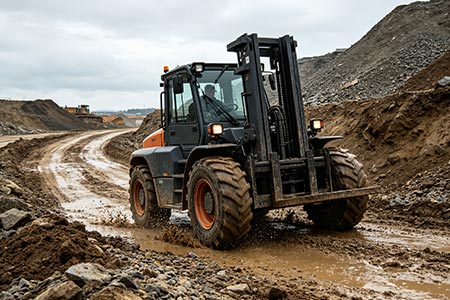
Indoor forklifts are normally fitted with PU wheels and shallow-pattern solid tires. Once covered with mud, these tires lose nearly all traction. The mountain off-road forklift comes standard with large-diameter deep-groove pneumatic or semi-solid off-road tires. The open tread realizes automatic mud removal. Larger tire contact area lowers ground pressure to avoid sinking on soft soil.
The excellent climbing capacity of 4WD all-terrain forklift originates from high ground clearance, four-wheel drive and deep-tread tires. When working on mountain terrain, the equipment delivers stable performance and guarantees cargo safety to bring reliable operation experience.
-
 Direct Source Factory for Small Electric Forklifts | NewnewtonBuying forklifts from source factories saves markup and speeds up after-sales service. Check qualifications carefully to distinguish real manufacturers from OEM traders.
Do you like ?0
Read more -
 5 Troubleshooting Reasons for Slow Lifting Speed of Electric ForkliftSlow fork lifting is a common electric forklift fault. Check battery voltage, hydraulic oil, filter, pump and multi-way valve to quickly locate the root cause.
Do you like ?0
Read more -
 Lithium-ion Warehouse Forklift Brands Review, Advantages and DisadvantagesLithium forklift brands vary greatly, including major manufacturers, original factories and dealers. Compare Heli, Hangcha, Noblift, BYD to select models matching your budget.
Do you like ?0
Read more -
 Price Reference of Hydraulic Dock Leveler for Warehouse Loading BayHydraulic dock levelers include fixed and mobile types with large price gaps. Load capacity, steel and hydraulic systems are key factors to consider for procurement.
Do you like ?0
Read more -
 Charging & Storage Taboos for Lithium-ion Double Pallet Electric TruckLithium battery double pallet trucks suffer heavy discharge under load. Follow charging, storage and operation rules to slow cell aging and cut replacement costs.
Do you like ?0
Read more -
 High-level Stacking Safety Notes for Electric Three-way ForkliftThree-way electric forklifts face collision and falling risks in narrow aisles. Follow standard operating procedures for pre-check, traveling, stacking and finishing to ensure warehouse safety.
Do you like ?0
Read more








