Walk‑Behind vs Stand‑On Electric Stacker | Core Differences & Selection
Many warehouse buyers cannot tell the differences between walk‑behind and stand‑on electric stackers, which often leads to unreasonable equipment selection and wasted budget. This professional comparison helps factories pick the most suitable stacking machine according to actual working conditions.
Operation Mode & Labor Intensity
A walk‑behind electric stacker requires operators to follow the machine on foot. Its lightweight structure and flexible steering make it convenient for short‑distance material shifting. Yet continuous walking causes physical exhaustion, so this type fits scenarios with low daily operation volume and intermittent handling tasks.
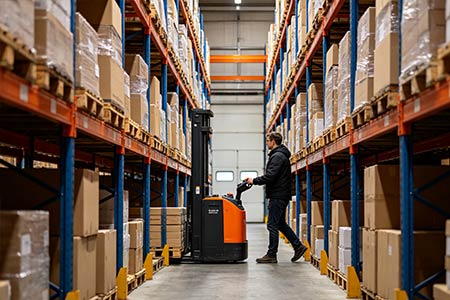
In contrast, the stand‑on electric stacker comes with a standing platform. Workers stand on the vehicle during traveling, which effectively reduces fatigue. It performs far better for long‑distance transportation and high‑frequency continuous warehouse operations.
Structural Performance & Operational Efficiency
The walk‑behind model features a compact body and small turning radius, adapting perfectly to narrow warehouse aisles. Due to lighter dead weight, it shows noticeable load attenuation at high lifting heights and is less suitable for long‑term heavy‑duty stacking.
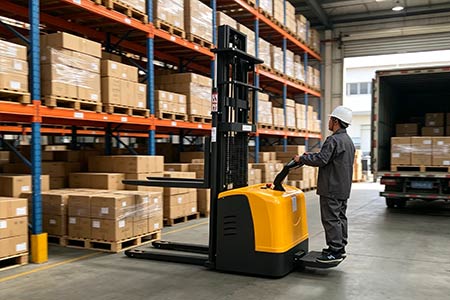
The stand‑on version has a heavier and more stable chassis. It provides stronger stability during high‑level stacking and faster traveling speed. With higher pallet handling capacity per hour, it greatly improves overall warehouse efficiency under continuous intensive workloads.
Cost & Power Consumption
Under identical load and lifting specifications, the walk‑behind structure costs less and consumes lower power during daily operation. It offers higher cost performance for factories with limited budget and irregular working shifts.
Benefiting from upgraded driving assemblies and standing platforms, the stand‑on model has higher initial investment. Its faster traveling speed brings higher working efficiency along with relatively greater energy loss.
Applicable Working Scenarios
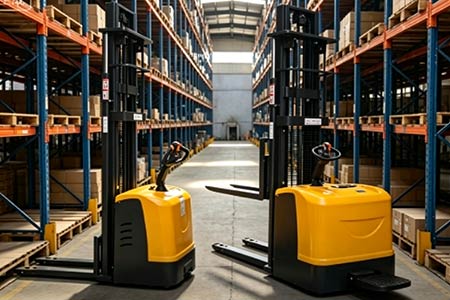
Compact walk‑behind stacking equipment is ideal for medium and small warehouses, workshop auxiliary material turnover, narrow aisle layouts and low‑frequency workloads.
Stand‑on stackers are widely adopted in e‑commerce warehouses and finished goods storage areas. They suit high throughput, long‑distance transportation and multi‑shift continuous operation where productivity is the top priority.
To conclude, select walk‑behind equipment for short‑distance, low‑frequency and budget‑limited scenarios. Choose stand‑on stackers for high‑turnover warehouses pursuing long‑time continuous operation and higher working efficiency. Reasonable selection based on aisle size and daily workload maximizes warehouse handling capacity.
-
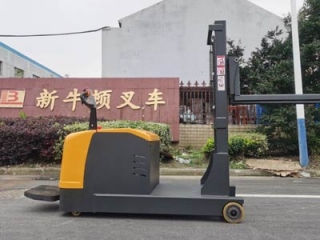 Stand‑On Counterbalance Stacker | OEM Custom ManufacturerStand‑on counterbalance stackers support OEM customization for special conditions. Differentiate simple branding from structural modification and confirm BOM list and delivery lead time.
Do you like ?0
Read more -
 Semi‑Electric Stacker | Buying Guide & Configuration ComparisonSemi‑electric stackers are cost‑effective for medium‑frequency stacking. Verify load margin, battery specs and mast workmanship to avoid false marking and insufficient battery runtime.
Do you like ?0
Read more -
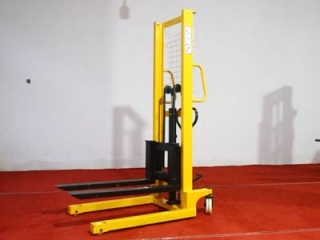 Hand‑Operated Forklift | Manual Hydraulic Stacker Warehouse Selection GuideManual hydraulic stackers feature low‑cost for light‑duty warehouses with low stacking frequency. Check load margin, lifting height and components to prevent potential faults and safety risks.
Do you like ?0
Read more -
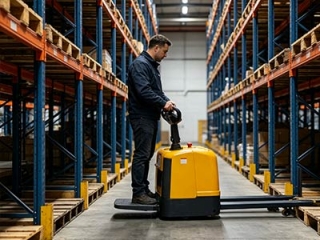 Stand‑On Electric Pallet Truck | Narrow Aisle Warehouse Buying TipsNarrow‑aisle pallet trucks suit old warehouses. Do not only refer to theoretical data; calculate actual aisle width, load margin and battery setup to avoid idle equipment waste.
Do you like ?0
Read more -
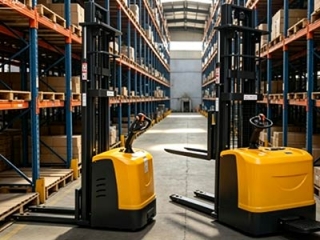 Walk‑Behind vs Stand‑On Electric Stacker | Core Differences & SelectionThere are obvious differences between pedestrian and stand‑on stackers. Choose according to warehouse aisle and daily workload for intermittent or high‑frequency operations.
Do you like ?0
Read more -
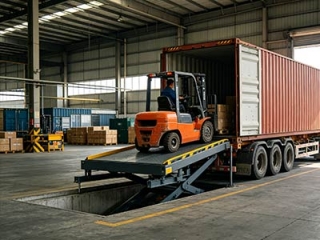 Hydraulic Dock Leveler | Four Types of Hydraulic Dock RampFour hydraulic dock ramp types for different scenarios. Wrong selection causes installation failure. Match civil‑work status and loading frequency to pick proper dock leveler.
Do you like ?0
Read more