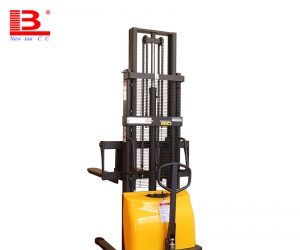
Semi‑Electric Stacker: Standard Operating Steps for Warehouse Handling
Learn the semi‑electric stacker operating steps before warehouse deployment, so operators can start work immediately after equipment arrival without delaying warehouse schedules. Improper operation may lead to cargo tipping, equipment damage and personal injury risks. Below is the standardized factory operating procedure for semi‑electric hydraulic stacker.
Pre‑operation Inspection
External structure: Check mast, forks and frame for deformation or cracks. Ensure chains are evenly tensioned without jamming; bolts and pins shall not be loose or missing. Hydraulic system: Verify oil cylinders and pipe joints have no oil leakage. Lifting motion shall be smooth with no stuck movement or abnormal noise. Battery & circuit: Confirm sufficient battery power. Connectors shall be tight and free of damage or exposed wires. Lifting buttons and switches shall respond sensitively. Travel & brake: Push the truck manually; wheels shall rotate freely without trapped debris. Braking system needs to be responsive and reliable. Working environment: Clear obstacles in aisles. Keep ground flat and dry, avoid oil stains and pooled water. Plan travel routes in advance for ramps.
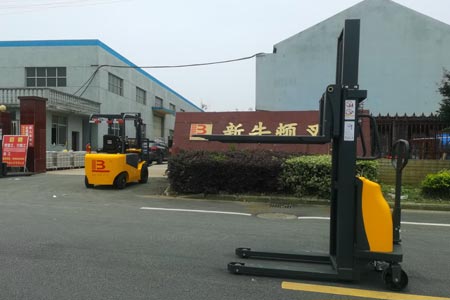
Standard Operation Procedure
Picking up cargo Manually push the semi‑electric stacker slowly toward the pallet. Keep forks horizontal and aligned with pallet openings, then push forward until forks fully go under the pallet. Center the load. Avoid offset loading, single‑side fork engagement or partial fork suspension.
Electric load lifting After confirming forks are fully inserted and cargo is stable, press the up button to lift forks at constant speed. Do not perform sudden lifting or lowering. After lifting cargo off the ground, check for tilting before transportation.
Manual transporting Keep forks 10‑20 cm above ground during transport to lower the center of gravity. Push at low steady speed. No fast running, sudden stops or sharp turns. Slow down in narrow aisles to avoid collisions with personnel. Never overload the truck. Do not carry passengers. Keep people away from fork area during movement.
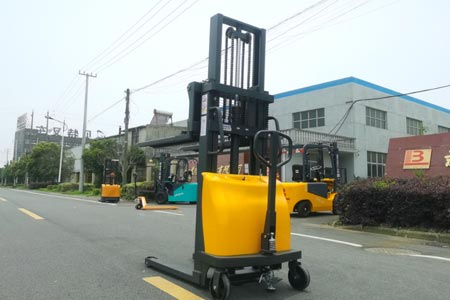
Stacking and unloading Push to the target stacking position and confirm no overhead obstacles. Lift forks smoothly to required height and align with rack position. Press down button to lower cargo steadily. After cargo is fully landed and forks are unloaded, back up and pull out forks to finish stacking. Do not force alignment at high height or drag loaded forks.
Post‑work shutdown When all tasks are finished, lower forks to the lowest position and power off the unit. Clean dirt and debris from forks and wheel gaps. Park in designated area, do not block main aisles or fire exits. Disconnect power for long‑term storage and recharge regularly to prevent battery damage from power loss.
This guideline serves for both equipment procurement and operator training for the semi‑electric hydraulic stacker, helping you put the forklift into service quickly.
-
 Newnewton Forklift Manufacturer, Forklift CE Certification for ExportNewnewton forklift factory offers full CE certification complying with EN ISO 3691, complete technical documents and OEM service to reduce customs detention risks.
Do you like ?0
Read more -
 Electric Forklift Vs Diesel Forklift, Warehouse Selection GuideElectric forklift is zero-emission and quiet for indoor clean warehouses. Diesel forklift offers strong power for outdoor heavy-duty tasks.
Do you like ?0
Read more -
 Narrow Aisle Stacker Forklift Custom Manufacturer for WarehouseCustom narrow aisle stacker for non-standard racking. Adjust body, mast and fork specs, upgrade power and protection, site survey available.
Do you like ?0
Read more -
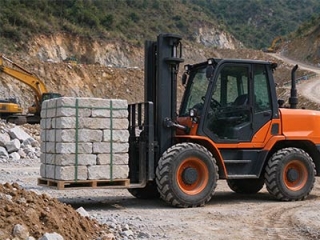 4WD All Terrain Rough Terrain Forklift Climbing for Mountain Sites4WD rough terrain forklift works on unpaved roads. Observe load climbing limit, attachments optional for forest and construction sites.
Do you like ?0
Read more -
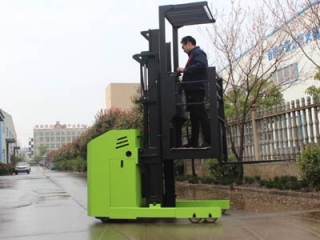 Man-Up Order Picker for High Level Picking, Suitable Warehouse ModesMan-up high level order picker for high-level split picking. Not for full pallet stacking, check rack, aisle and floor before selection.
Do you like ?0
Read more -
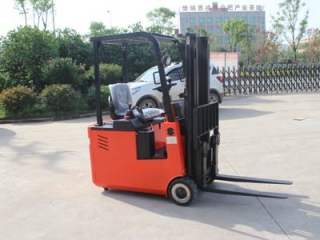 Narrow Aisle Operation Of Three-Wheel Forklift With Compact Turning RadiusThree-point electric forklift features small turning radius for narrow aisles. Reserve safety margin and check floor condition during selection.
Do you like ?0
Read more