
How To Select Suitable Ride-on Reach Stacker Based On Warehouse Parameters
Many factory owners lack sufficient knowledge of reach stackers and worry about improper parameter selection leading to poor operation. To avoid common post-purchase issues including insufficient lifting capacity, narrow aisle access failure, short battery life and wobbly masts, we sort out all critical technical parameters of the Ride-on Reach Electric Stacker for your reference.
Rated Load Capacity & Load Reduction Curve
Mainstream reach stackers come in 1t, 1.5t and 2t load grades. You should reserve a 20% safety margin above your maximum pallet weight during selection; long-term full-load operation accelerates aging of motors and hydraulic assemblies.
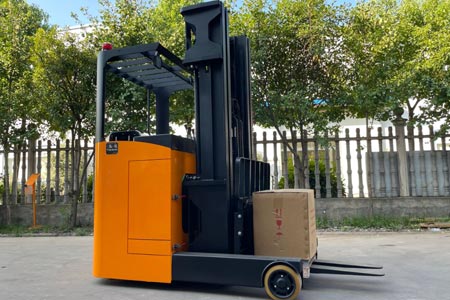
A unique characteristic of reach stackers is load capacity attenuation: the higher the lifting height, the lower the actual load capacity, which is easily overlooked by buyers. Example: A 1.5-ton reach stacker can carry full rated weight at 3m lifting height, while its effective load drops to only 800kg at 6m. For racks above 8m, residual load capacity decreases further. Factories with high-level heavy stacking must request official load attenuation charts from manufacturers to prevent failure to lift goods at high heights.
Also confirm load center distance (standard 500mm). Overlength cargo shifts the center of gravity and further cuts the maximum bearing weight.
Full Load Gradeability
Ramps and loading docks in workshops usually have a gradient of 6%–10%. National standard reach stackers deliver a minimum 6% full-load climbing capacity. For sites with frequent ramp and dock access, custom 8% high-climbing models are recommended to avoid insufficient uphill power and vehicle sliding that damage drive motors.
Maximum Mast Lifting Height
2–layer low racks (3–4.5m): 2-stage full free mast
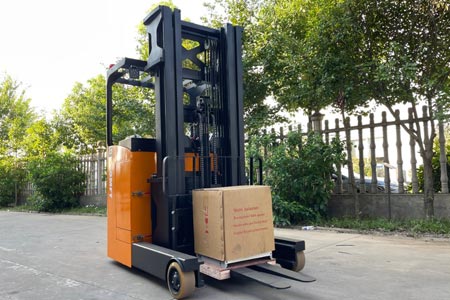
4+ layer high-rise rack warehouses (6–12m): 3-stage or 4-stage full free mast When choosing the Ride-on Reach Electric Stacker, reserve a 200mm top safety clearance to avoid collision with factory lamps and fire pipes.
Collapsed Mast Height
This refers to the overall height when the mast is fully retracted, which determines whether the forklift can pass workshop doors and freight elevators. Low-ceiling plants prefer 3-stage masts with lower collapsed height; 2-stage masts have higher retracted height and cannot operate normally in limited-height warehouses.
Free Lift Height
3-stage masts offer 1200–1500mm free lift, preventing top cargo collision during truck loading/unloading and low rack access. 2-stage masts only provide 80–120mm free lift, not applicable for multi-layer high storage.
Minimum Right-angle Stacking Aisle
The biggest advantage of reach stackers is narrow aisle adaptability. Standard models require 2.6–3m aisles, while customized narrow-chassis versions cut this below 2.5m. Compared with conventional counterbalance forklifts, they save 0.6m aisle width and raise rack layout density by 30%. Measure your actual clear rack aisle width before purchase; pick slim-body models if aisles are narrower than 2.6m. This is one of the most critical points within Key Parameters to Check When Buying Reach Stackers For Factories.
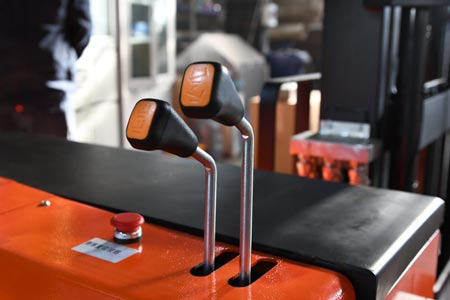
Overall Body Width & Fork Reach Stroke
Standard body width: 1250–1400mm; standard reach stroke: 550–650mm, matching common 1200mm industrial pallets. Custom extended reach stroke is available for extra-long non-standard pallets.
Chassis Ground Clearance
Standard clearance ranges from 80–120mm for smooth crossing of workshop speed bumps and floor joints. For uneven factory ground with large height differences, order raised ground clearance to prevent chassis scraping damage.
Besides the above specs, battery capacity of the Ride-on Reach Electric Stacker is another vital factor covered in Key Parameters to Check When Buying Reach Stackers For Factories. We will cover this in later articles, or you may contact us directly for complete detailed parameters.
-
 Newnewton Forklift Export, Canton Fair Electric Warehouse Forklift ManufacturerAt the 140th Canton Fair, Newnewton displays full electric warehouse equipment, including cold storage and explosion-proof models with CE, OEM and export support.
Do you like ?0
Read more -
 Electric Forklift Factory Direct Quotation, Warehouse Handling EquipmentSame model electric forklifts have varied quotes due to different configurations. Provide load, lift, working conditions and certifications for accurate direct factory pricing.
Do you like ?0
Read more -
 5 Common Working Scenarios for Customized Warehouse Forklift SolutionsStandard forklifts fail to fit special warehouse conditions. The factory offers customization for narrow aisles, cold rooms, explosion-proof and outdoor heavy-load scenarios.
Do you like ?0
Read more -
 What Tests Are Conducted Before Explosion Proof Forklift DeliveryExplosion-proof forklifts are for flammable and dusty warehouses. They pass strict tests on structure, electrics, temperature and hydraulics before delivery.
Do you like ?0
Read more -
 How to Maintain Internal Combustion Forklift in Cold WinterInternal combustion forklifts suffer hard starting and fuel icing in cold weather. Maintain fuel, oil, battery and cooling systems for winter use.
Do you like ?0
Read more -
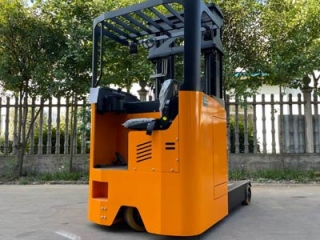 2 Ton Sit-down Reach Stacker, Sit-on Electric Reach Stacker2-ton seated reach stackers fit narrow aisle high rack warehouses. Its extending mast works for two-shift stacking; watch aisle size and high lift capacity deration.
Do you like ?0
Read more








