
New Newton Forklift Electric Stacking Truck Special Coty Speed Controller
(1) Structure of Curtis Electric Stacking Vehicle Controller
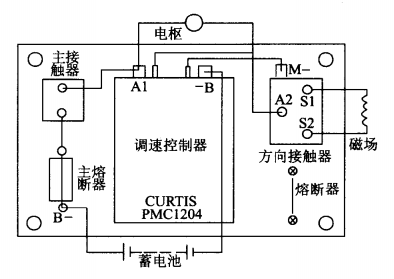
The new Newton forklift uses the Curtis speed controller on electric stackers and battery tractors, with a working voltage of 40V, a maximum allowable current of 175A~275A, a rated current of 130A~200A for 5 minutes, and a working current of 75A~125A for 1 hour. The structure of the Curtis controller is shown in the following figure.
The above diagram shows the circuit of Curtis PMC1204/05 speed controller controlling electric traction vehicles. The main circuit of the motor in the figure is composed of a battery, the main fuse FU4, the contact of the circuit contactor K, the armature and magnetic field of the motor, the contact of the directional contactor, the power transistor, and the freewheeling diode. When the contact of circuit contactor K is closed, the normally open contact of direction contactor F is connected (and at the same time, its normally open contact drives the working current of the motor, which is controlled by the MOSFET power transistor in the controller). The motor will be powered forward and the vehicle will move forward, as shown in the following figure.
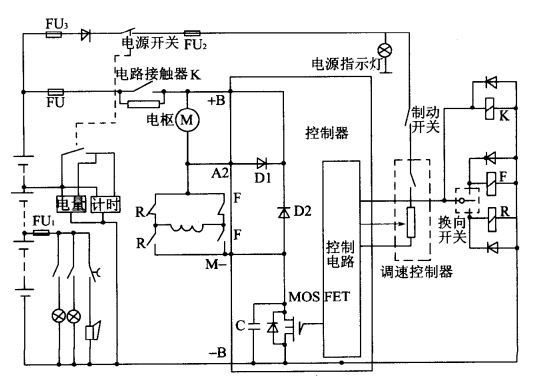
The operating speed of electric stacker vehicles depends on the conduction time or relative conductivity of MOSFETs. The longer the conduction time of power transistors, the higher the voltage applied to the motor, the greater the working current of the motor, the higher the output torque and speed of the motor, and thus the higher the operating speed of the vehicle. The rotation direction and speed of the New Newton forklift motor are controlled by a control circuit. Turn on the power switch and the power indicator light will light up.
Release the brake pedal and turn on the brake switch. Turn on the direction switch (to determine the direction of vehicle operation), press the pedal of the speed control controller, and the starting switch inside it is turned on. The circuit contactor K coil is energized, and the main contact K is closed, connecting the main circuit of the electric motor. At the same time, the coil of the directional contactor F or R is energized, and the corresponding contact (F or R) acts to determine the direction of rotation of the motor, that is, the direction of vehicle operation. Continuing to press the governor pedal, the resistance value of the variable resistor in the governor changes, changing the signal value of the input control circuit. The control circuit increases the conduction time or relative conductivity of the MOSFET tube, and the vehicle's operating speed increases.
If the brake pedal is pressed during the operation of the electric stacker vehicle, the brake switch will be disconnected, and the vehicle circuit will be cut off immediately. If the direction switch is turned to the opposite position during vehicle operation, the vehicle cannot immediately change direction and will first stop running; When the vehicle speed decreases to zero, lift the speed control pedal and press it again before the new Newton forklift vehicle can run.
-
 Operation Notes for Electric Self-elevating Truck | Truck Mounted Forklift SafetTruck-mounted self-loading forklifts fixed on truck tails handle cargo without loading docks. Control load and cargo gravity, inspect equipment and avoid soft slopes to prevent tipping and falling goods.
Do you like ?0
Read more -
 Warehouse Double Pallet Truck vs Standard Pallet JackDouble pallet jacks differ greatly from standard models in applicable working conditions. Double pallet jacks deliver higher handling efficiency but require wider aisles and better floors, while ordinary jacks are compact and cost-effective for general wa
Do you like ?0
Read more -
 Stand-on Reach Stacker Pros & Cons for Narrow Aisle High-rack WarehousingStand-on reach stackers suit dense narrow-aisle warehouses with a movable mast and 6-meter maximum lifting height. They boost storage capacity but feature complex structures, higher maintenance costs and stricter floor requirements.
Do you like ?0
Read more -
 Walk-behind Counterbalance Stacker Wholesale Cost & Warehouse Buying GuideStand-on reach stackers suit dense narrow-aisle warehouses with a movable mast and 6-meter maximum lifting height. They boost storage capacity but feature complex structures, higher maintenance costs and stricter floor requirements.
Do you like ?0
Read more -
 Legless Stand-on Counterbalance Stacker Minimum Stacking Aisle Parameter GuideStand-on counterbalance stackers rely on counterweights for stability without support legs. Its right-angle stacking aisle ranges from 1900mm to 2200mm, requiring reasonable spacing planning for safe operation.
Do you like ?0
Read more -
 Narrow Aisle Walkie Electric Pallet Jack Wheel Replacement StepsTire wear of pedestrian electric pallet trucks in narrow aisles easily causes slipping and shelf collision issues. Standardize the full tire replacement process and maintenance steps to ensure stable operation.
Do you like ?0
Read more








