On‑board Self‑lifting Truck Principle | Electric Self‑loading Stacker
Urban distribution fleets often face tough unloading troubles: delivery destinations lack forklifts or loading docks. Hiring temporary porters brings extra cost and waiting time. Manual handling by drivers causes heavy labor and safety risks. Truck tail‑gate modification costs high and meets annual‑inspection restrictions in some regions. Under such conditions, electric self‑loading stacker becomes a practical solution.
Before procurement, understanding on‑board self‑lifting truck principle helps you avoid misleading parameter propaganda and master its loading‑unloading and truck‑boarding operation logic.
Equipment Structure
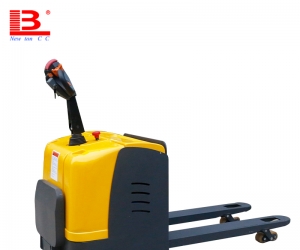
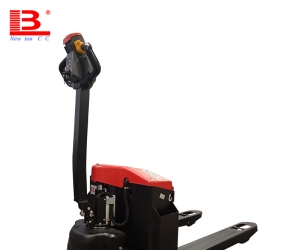
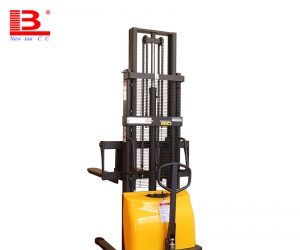
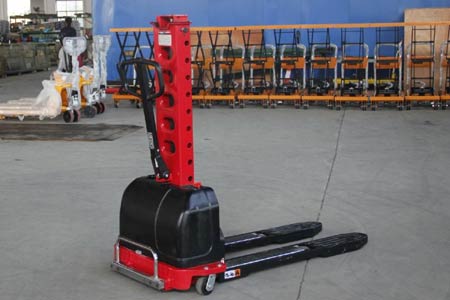
The machine mainly consists of four assemblies: traveling chassis, hydraulic lifting mechanism, battery & controller system and vehicle locking mechanism. Normally stored inside truck cargo box, it can get on and off trucks easily via retractable support legs. Battery supplies power for travel drive and hydraulic power unit. Oil cylinder pushes lifting frame to lift pallets up to truck floor height, realizing cargo transfer between ground and truck compartment.
Hydraulic Working Principle
Hydraulic lifting serves as core functional unit. When operating handle sends signals, motor drives hydraulic pump to build oil pressure. Oil cylinder extends to push lifting frame and forks rise accordingly. For lowering, hydraulic circuit releases pressure and forks descend steadily.
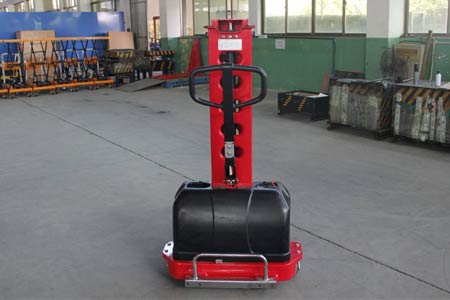
Built‑in overflow valve and burst valve provide dual safety protection. Overload triggers automatic pressure relief to protect whole unit. Even if hydraulic tube ruptures accidentally, forks will not drop rapidly to safeguard operators. There are semi‑electric and full‑electric versions available. Semi‑electric model only offers electric lifting while movement relies on manual pushing. Full‑electric type is equipped with drive motor for autonomous travel and self‑boarding onto truck, greatly reducing manpower demand.
With knowledge of on‑board self‑lifting truck principle, you shall select models according to real‑world fleet conditions. Semi‑electric version delivers better cost‑performance for low‑frequency unloading tasks. Full‑electric unit is recommended for high‑frequency multi‑stop distribution to cut physical workload.
-
 Reliability Of Newnewton Warehouse Forklifts For Heavy-Duty ShiftsWarehouse forklift reliability relies on industrial parts, reinforced frames and factory durability tests. Proper operation and maintenance reduce unexpected downtime.
Do you like ?0
Read more -
 Forklift Configuration Strategy For Dense Warehousing, Warehouse ForkliftDense warehousing needs matched forklifts besides racks. Reach and trilateral stackers fit different layouts, coordinate aisle, load curve and floor for smooth handling.
Do you like ?0
Read more -
 Full Container Supply For Export Forklifts, Forklift ManufacturerBulk forklift orders for overseas can ship by FCL or LCL. Newnewton FCL offers stable freight, safer packing and mixed models for large purchases.
Do you like ?0
Read more -
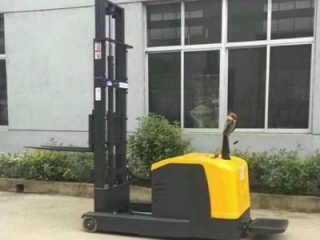 Stand-on Reach Stacker For Narrow Aisle Stacking, Mast Reach StructureStand-on reach stackers feature sliding masts that stay outside racks. They boost storage density in narrow aisles and require flat floors and standard pallets.
Do you like ?0
Read more -
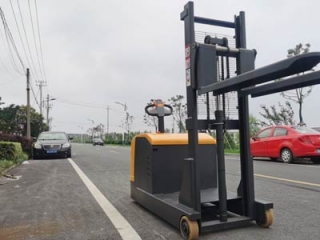 Stand-on Counterbalance Stacker For Various Pallets, Why No Leg RestrictionCounterbalance stackers have no front outriggers, using rear counterweight to avoid pallet interference. They fit various odd pallets yet need wider warehouse aisles.
Do you like ?0
Read more -
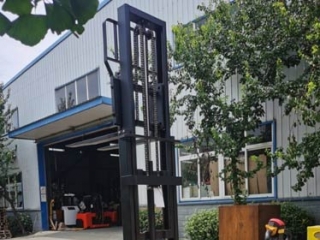 Custom Walk-Behind Counterbalance Stacker | Non-Standard ModificationsStandard walk-behind counterbalance stackers struggle with non-standard pallets and tight aisles. Customize load, lift, forks and structure, share working conditions for safe design.
Do you like ?0
Read more