
The circuit of an electric forklift shown in Figure 1 is a schematic diagram of the principle of a DC motor. The magnetic poles N and S are a pair of magnetic poles generated by the main magnetic pole, and the coil abcd represents the armature coil (winding); A and B represent inverters, small squares represent brushes, and U represents the applied power voltage. As shown in Figure 1:
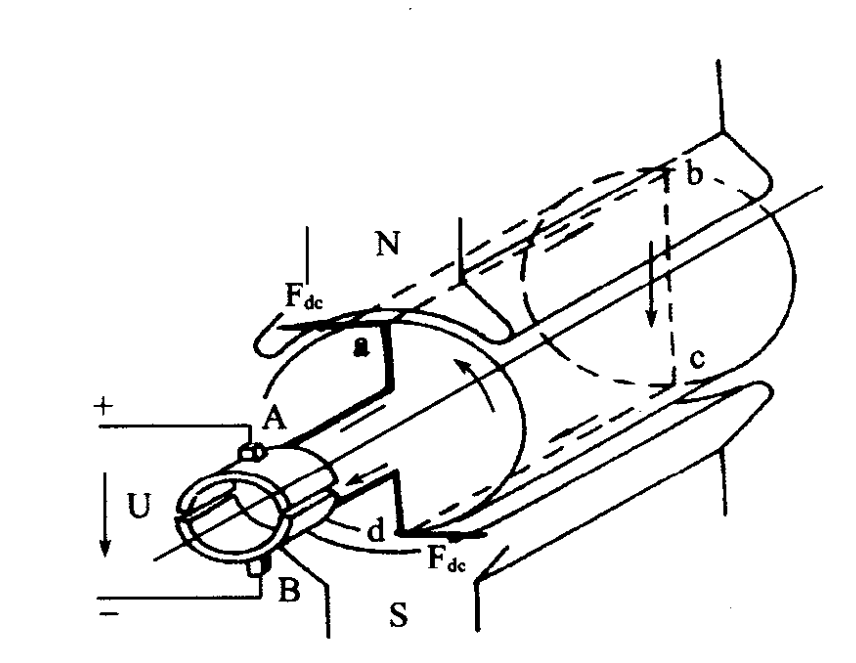
We know that the electrified conductor of an electric forklift motor is subjected to a force in a magnetic field, and the direction of the force is determined using the left-hand rule. The current on edge ab in the figure is from a-b; The current on the edge of cd is cd. Therefore, according to the left-hand rule, it can be determined that the force Fa on edge ab is to the left, while the force F on edge cd is to the right. Therefore, the coil abed is subjected to a counterclockwise rotation torque.
When the DC motor coil abcd rotates 180 degrees, the ab and cd edges align with the position shown in the diagram, and the commutator also rotates 180 degrees with the coil. As a result, the current direction of ab and cd edges is reversed. According to the left hand rule, it is determined that the force on edge cd is to the left, while the force on edge ab is to the right. The coil abcd is still subjected to a counterclockwise torque. Therefore, the coil, along with the armature core, rotates, which is the working principle of a DC motor. So, what factors are related to the torque received by the armature? From the working principle of an electric motor, it can be seen that the greater the magnetic flux generated by the main magnetic pole, the greater the current flowing into the armature winding, and the more windings the armature winding are, the greater the torque received. Since this torque is generated by the interaction between current and magnetism, we call it electromagnetic torque, represented by T. Obviously, the electromagnetic torque T can be expressed as follows:
T=CTIAφ
In the formula: C-and motor structure
I - Current in the armature;
φ— The magnetic flux of a magnetic field.
Due to the magnetic field lines generated by the armature winding (conductor) of the electric forklift DC motor cutting the main magnetic pole during rotational motion, an induced electromotive force is also generated in these windings (conductors). This induced electromotive force is opposite to the direction of the applied voltage, so it is called a back electromotive force, denoted as E. express. The magnitude of the back electromotive force EA is obviously related to the strength of the magnetic field and the speed of the rotation, and its expression is:
EA=CePn
In the formula: Ce - constant related to the motor structure;
Φ—— The magnetic flux generated by the main magnetic pole;
N-speed of an electric motor.
-
 Taizhou newnewton Forklift Manufacturer IntroductionAvoid selecting warehouse forklifts only by unit price. Check site conditions, certificates and after-sales. Newnewton, Taizhou source factory, provides full product range, CE certification, customization and reliable spare parts supply.
Do you like ?0
Read more -
 Semi-electric Stacker vs Manual Stacker Cost ComparisonWhen buying stacking equipment for small warehouses, compare semi-electric stackers and manual stackers from cost, efficiency and maintenance to balance upfront expense and long-term investment.
Do you like ?0
Read more -
 CE Certification for Manual Hydraulic StackerNewnewton manual hydraulic stackers exported to EU need CE certification complying with 2006/42/EC and EN1757-1, including safety assessment, technical documents and product compliance checks.
Do you like ?0
Read more -
 Stand-on vs Walk-behind Electric Pallet Truck ComparisonUnderstand the differences between stand-on and pedestrian electric pallet trucks in operation, efficiency, aisle requirements and costs. Choose the right model based on warehouse scale, transfer distance and order volume.
Do you like ?0
Read more -
 Operation Notes for Electric Self Elevating TruckPedestrian electric stackers cover tiered brand options with different features. International brands offer stable performance at high cost, while domestic brands and factory suppliers provide better cost performance and customization.
Do you like ?0
Read more -
 Operation Notes for Electric Self-elevating Truck | Truck Mounted Forklift SafetTruck-mounted self-loading forklifts fixed on truck tails handle cargo without loading docks. Control load and cargo gravity, inspect equipment and avoid soft slopes to prevent tipping and falling goods.
Do you like ?0
Read more








