Double Pallet Stacker Maintenance | 4 Cycles of Professional Servicing Tips
The rider‑operated double‑pallet stacker is widely used in e‑commerce warehouses and high‑turnover storage scenarios. High‑frequency operation brings heavy load to the whole unit. Without periodic electric double‑pallet stacker maintenance, faults such as jerky lifting and steering failure may occur, delaying schedules and lowering goods turnover efficiency. Below are four key scheduled service points.
Daily maintenance (after each shift) Daily service focuses on visual inspection and function check after every working shift. Clear carton scraps, plastic straps and dust from forks, mast chains and wheel gaps to avoid foreign‑object jamming on moving parts.
Check forks for deformation and cracks, inspect chain slackness. Test lifting, travelling, brake and emergency‑stop functions. Monitor battery level and recharge in time to prevent deep discharge. Park equipment in designated area with forks fully lowered and cut off power. Record abnormalities including oil leakage and strange noise. Do not operate faulty units on next working day.
Weekly maintenance (accumulated 40‑50 working hours) Weekly service mainly covers transmission and movable mechanical parts. Apply grease to mast chains and roller bearings to reduce wear and abnormal noise. Keep left and right chains at identical tension.
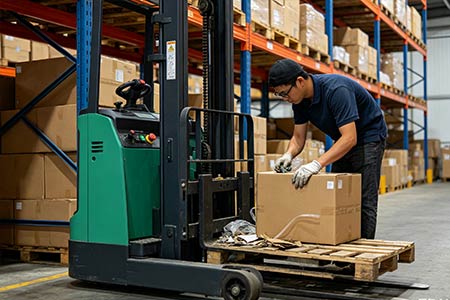
Tighten bolts on chassis and mast, inspect pipe joints for oil seepage. Mark heavily‑worn drive and load wheels for upcoming replacement. Keep battery terminals clean, non‑oxidized and firmly connected. Run full no‑load lifting cycles to check hydraulic pressure‑drop and sliding risks.
Monthly maintenance (accumulated 180‑200 working hours) Monthly service carries out in‑depth inspection for hydraulic and electrical systems. Check hydraulic oil level; replace oil once it turns turbid or black. Inspect hydraulic hoses and sealing rings, replace aged cracked components to eliminate oil leakage risks.
Examine wiring of controller and motor, wipe dust from electric cabinet. Never wash electric components directly with water. Calibrate brake performance and adjust excessive brake clearance. Since rider‑operated double‑pallet stacker is equipped with dual fork assemblies, verify lifting synchronization of two fork groups. Adjust chains and hydraulic circuits if out‑of‑sync phenomenon appears.
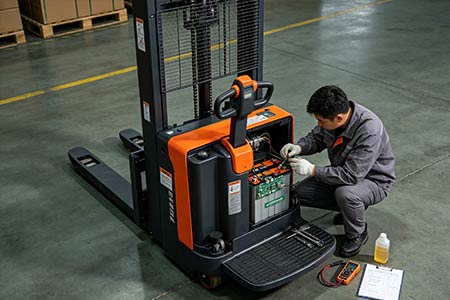
Quarterly maintenance (accumulated 500‑600 working hours) Quarterly deep maintenance is recommended with support from professional technicians. Retighten all fasteners across the truck. Measure chain elongation and replace over‑stretched chains to avoid breakage hazard.
Test single‑cell voltage and evaluate battery health status. Check lithium‑ion cell and BMS board; for lead‑acid battery, inspect electrolyte level. Verify all safety devices including limit switches, emergency stop and overload protection.
Measure mast roller wear and fork deformation. Sample hydraulic oil and perform oil change upon service interval. Complete no‑load and half‑load test after maintenance. Confirm dual‑fork synchronous lifting, travelling and braking work properly before putting back into production.
In short, standardized electric double‑pallet stacker maintenance effectively cuts failure rate, stabilizes inbound‑outbound efficiency for e‑commerce warehouses and brings long‑term value.
-
 Top 10 Electric Forklift Brands: What Buyers Should KnowOnline electric forklift rankings are for reference only. Divide brands into three tiers, compare working conditions, budget and after‑sales for high‑frequency heavy‑load or non‑standard customization.
Do you like ?0
Read more -
 Key Points For OEM Customization Of Double Pallet JackCustom dual‑pallet electric trucks face mismatched conditions and delays. Follow GB/T 26949 stability standards, confirm BOM and CE documents, and test prototypes before mass production.
Do you like ?0
Read more -
 How To Select Reliable Manual Forklift Manufacturer In JiangsuMany manual pallet truck suppliers in Jiangsu. Distinguish real manufacturers from traders, check JB/T3341 quality, customization and CE documents to avoid inferior low‑cost goods.
Do you like ?0
Read more -
 How To Select Reliable Manual Forklift Manufacturer In JiangsuMany manual pallet truck suppliers in Jiangsu. Distinguish real manufacturers from traders, check JB/T3341 quality, customization and CE documents to avoid inferior low‑cost goods.
Do you like ?0
Read more -
 What Makes Rider‑Operated Full‑Electric Stacker Stand Out In Busy WarehouseStand‑on electric stackers deliver 15‑25% higher efficiency than walk‑behind models. Comply with GB/T26949.4 for better stability, suitable for multi‑shift high‑frequency warehouse operations.
Do you like ?0
Read more -
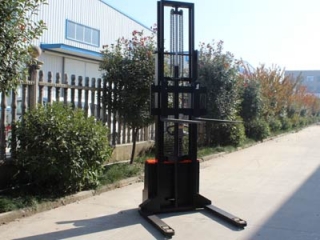 Straddle‑Leg Electric Stacker: Which Working Conditions Fit BestStraddle electric stackers with adjustable leg spacing avoid pallet jamming, ideal for small and medium indoor warehouses. Not suitable for high lifting, single-sided pallets and uneven outdoor ground.
Do you like ?0
Read more